- Aid Pioneers
- Bugia Sunrise
- Cameroon Agenda for Sustainable Development
- Cherish Uganda
- Good Shepherd Foundation
- Healey International Relief Foundation
- Helping Children Worldwide
- Hispanola Health Partners
- Juniors Place of Hope
- Maison de Naissance (Global Birthing Home Foundation)
- Midwives for Haiti
- Miracle of Help
- Mission of Hope Rotifunk
- Naye Xjaw (Maya Midwifery International)
- Partners for World Health
- Rural HealthCare Initiative
- Sozo Children
- Tenki for Born
“I feel supported by others with many of the same challenges in the global health field. TGH has provided some great connections to other organizations for resources and knowledge.”
Carol Nelson, Executive Director of Rural Healthcare Initiative
What We Do
We maximize the impact of grassroots community-based partners providing healthcare and educational services by:
- Mobilizing resources
- Joint advocacy
- Sharing best practices widely
- Nurturing cross-project collaboration and programming and,
- Direct capacity-building support when needed to enable each project to be sustainable and thrive
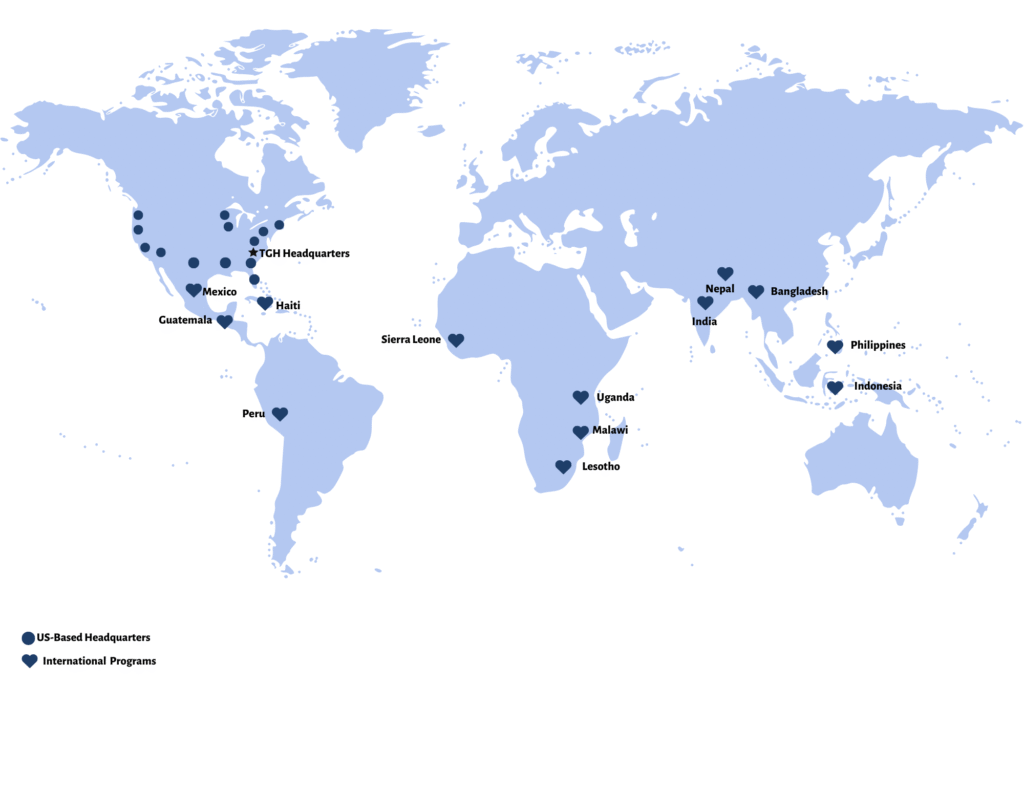
Network Partners are on the ground providing life-saving services and education to minimize maternal and newborn mortality using a person-centered model of care. Our goal is to expand the circle of Partners to as many countries and communities as possible in the next 5 years.
Many participating Partners have been on the front lines of disaster relief during humanitarian crises, staffing large refugee encampments and after major natural disasters affecting already-vulnerable communities on every continent where we work.
Collective Impact
- Dramatic reduction of maternal and infant mortality in every location; most Partners have a track record of zero maternal deaths and a dramatically smaller ratio of newborn deaths compared to their countries’ averages
- Establishment and operation of community birth centers run by local staff, most in remote areas where there is little or no healthcare for families
- Training of thousands of birth workers including midwives, skilled birth attendants, traditional birth attendants, community health workers, and nurses
- Improved community well-being including access to nutrition support, family planning, reduction of unwanted teen pregnancies, lower rates of STD’s, prevention of HIV transmission, cleaner water, improved sanitation, and in some cases, free or low-cost education for children, job skills training and access to paid work for mothers. Partners work in their local communities to determine culturally appropriate priorities and projects